Posts

Types of Rubber, their Properties and Applications
Image
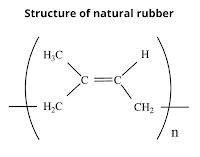
1. Natural Rubber Natural rubber is a natural polymer that is manufactured from latex which is a colloidal solution of rubber particles in water. Latex is obtained by making cuts in the bark of rubber trees like Hevea brasiliensis, found in tropical and semi-tropical countries such as southern. India, Indonesia, Malaysia, Sri Lanka, South America, etc. The natural rubber has remarkable elasticity and undergoes long-range reversible extension even under a relatively small applied force. Preparation of natural rubber Natural rubber is a linear 1,4-addition polymer of isoprene. Since each repeating unit in polyisoprene contains a double bond having cis-stereochemistry. That's why natural rubber is cis-polyisoprene. Properties of Natural rubber Natural rubber has no polar groups and hence intermolecular forces of attraction are only weak van der Waals interactions. Cis-polyisoprene does not have a straight-chain but has a coiled structure. As a result, it can be stretched like a spri...

Malachite Green: Definition, Synthesis, Properties and Applications

Image
What is Malachite Green? Malachite green is a type of Triphenyl methane dye that is used as a dyestuff for materials like silk, leather, and paper. It is bright green and can be used as an antimicrobial agent in aquaculture. Synthesis of Malachite Green Malachite green can be prepared by reaction of Benzaldehyde with N, N-dimethyl aniline in the presence of H₂SO₄ to form a triphenylmethane derivative. The subsequent oxidation with PbO₂ followed by treatment with an excess of concentrated HCl yields a green dye known as malachite green. Properties of Malachite Green Malachite green is green, crystalline, and water-soluble. Leuco form of malachite green is electrically neutral and undergoes a photoionization reaction that yields the cationic form of malachite green. It is toxic, thus not advisable to consume. Applications of Malachite Green It is used as a dye to color materials like silk, leather, and paper. It is used as an antiseptic for bacterial infection. It is used to catch thi...

Conducting Polymers: Definition, Examples, Properties and Applications

Image
What are Conducting Polymers? As the name suggests organic polymers that conduct electricity are known as conducting polymers. They are also known as intrinsically conducting polymers (ICPs) and they have alternating single and double bonds along the polymer backbone (conjugated bonds) or that are composed of aromatic rings such as Phenylene, naphthalene, anthracene, pyrrole, and thiophene which are connected through carbon-carbon single bonds. Examples: Polyacetylene, Polypyrrole, Polyaniline, etc What is the reason behind conducting nature of these polymers? Conducting polymers comes in two forms that are doped conducting polymers and non-doped conducting polymers. The conductivity of non-doped conjugated polymers is due to the existence of a conductivity band similar to a metal. In a conjugated polymer, three of the four valence electrons form strong sigma bonds through sp² hybridization where electrons are strongly localized. The remaining unpaired electron of each carbon atom re...

Alizarin Dye: Definition, Synthesis, Properties and Application

Image
What is Alizarin Dye? Alizarin is a red dye having chemical formula C₁₄H₈O₄ which is generally used to dye cotton, wool, and silk.  Alizarin was originally obtained from the root of a common madder plant called Rubia tinctorum. It is also known as Turkey Red as it was best dyed in Turkey and in 1869, it becomes the first natural dye to be duplicated synthetically. Synthesis of Alizarin Following are some methods for the synthesis of alizarin: 1. From anthraquinone The starting material for the synthesis of alizarin is an anthraquinone. It can be easily obtained by Friedel-crafts acylation of benzene with phthalic anhydride. Anthraquinone is then sulfonated with concentrated sulphuric acid at a high temperature to give anthraquinone-b-sulphonic acid. Alizarin is obtained by fusion of anthraquinone-b-sulphonic acid with caustic soda. 2. By bromination of anthraquinone Another synthesis is given by Graeve (in 1869). In this method, anthraquinone is brominated to yield dibromo anthr...

Crime Scene: Definition, Types and Characteristics

Image
What is a Crime Scene ? A place where the crime is committed or where the maximum physical evidence related to crime is found is known as a crime scene. A crime scene is a starting point of the investigation which provides information about the suspect and the victim. This helps to reconstruct the crime and fast resolution of the case. It is noted that the crime scene is not limited to a single place but may extend to a wider area depending upon the nature of the crime committed. For example, In a murder case where murder is done at one place and the body is disposed on another place. In this case, we have two crime scenes that give information about the crime. Types of Crime Scene Based on evidence found on the crime scene: 1. Primary Crime Scene The crime scene where the actual crime occurred or where more usable pieces of evidence were found is known as the primary crime scene. For example, A murder scene, theft, assault, etc. 2. Secondary Crime Scene The crime scene which is some...

Degree of Crystallinity: Definition, Factors Affecting and Determination Methods

Image
What is Degree of Crystallinity? The degree of crystallinity of the polymer is defined as the fraction of the sample which is crystalline. It can be either expressed in terms of the mass fraction or the volume fraction. The degree of crystallinity by a volume fraction is given by Where,  Xₘ = Degree of crystallinity by mass V = Specific volume of the sample Vₐ = Specific volume of fully amorphous polymer Vc = Specific volume of fully crystalline polymer Factors affecting the degree of crystallinity 1. Molecular weight With the increase in molecular weight of the polymer, the degree of crystallinity increases due to a large number of entanglement of the chain which restricts the growth of a crystallite. 2. Symmetry of repeating unit A symmetrical repeating unit structure like CH₂ makes it easier for the formation of crystallites. Thus, increasing the degree of crystallinity. That's why random copolymers do not crystallize because there is no regularity of the repeating unit. 3. Chai...

Silicone Polymers: Definition, Preparation, Properties and Applications

Image
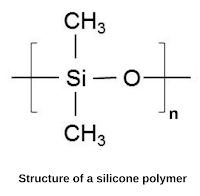
What are Silicone Polymers? Silicones are polymeric organosilicon compounds containing (Si-O-Si) linkages and have the general formula (R₂SiO) . They are typically colorless, oils, or rubber-like substances that may be linear, cyclic, or crosslinked.  Silicone polymers have very high thermal stability and are also called high-temperature polymers. They are widely used in sealants, adhesives, lubricants, medicine, and cooking utensils. Preparation of Silicone Polymer When methyl chloride reacts with silicon in the presence of copper as a catalyst at a temperature of 570 K , various types of methyl-substituted chlorosilanes are formed. Hydrolysis of dimethyldichlorosilane that is (CH₃)₂SiCl₂  followed by condensation polymerization forms straight-chain polymers called silicone polymers. Properties of Silicone polymer 1. It has low thermal conductivity, chemical reactivity, and toxicity. 2. They have low surface tensions and are capable of wetting most surfaces. 3. It does not s...

Styrene Copolymers: Types, Preparation, Properties and Applications

Image
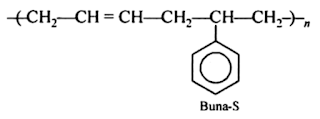
1. Butadiene-styrene Copolymer (SBR or Buna-S) Buna-S or SBR is a copolymer of 1,3-butadiene and styrene which is prepared by copolymerization of 1,3-butadiene and styrene along with sodium. In Buna-S, Bu stands for butadiene, Na for sodium which is the polymerizing agent and S stands for styrene. It is tough and is a good substitute for natural rubber. It possesses high abrasion resistance, high load-bearing capacity and is used for the manufacture of automobile tires. Preparation of Buna-S Styrene-butadiene rubber (SBR) or Buna-S can be prepared by copolymerization of a mixture of 1,3-butadiene and styrene in the ratio of 3:1 in the presence of sodium. Properties of Buna-S 1. Buna-S has high abrasion resistance, high bearing capacity, and resilience. 2. Buna-S is very tough and is a good substitute for natural rubber 3. Buna-S swells in organic solvents up to a limited extent. 4. Buna-S gets oxidized in the presence of traces of ozone. Applications of Buna-S 1. Buna-S is used for ...

Polyolefins: Types, Properties and Applications

Image
What are Polyolefins? A polymer that is produced from a simple olefin monomer (also called alkene having general formula CₙH₂ₙ) is called Polyolefin . For example (a) Polyethene is a polyolefin produced by polymerization of olefin ethylene (b) Polypropylene is a polyolefin produced by polymerization of olefin propylene. The IUPAC nomenclature of polyolefins is poly (alkene) . Polyolefins are produced by different common forming techniques like injection molding, blow molding, extrusion, and thermoforming using standard thermoplastic equipment. Due to low prices and easy processability, polyolefins have a variety of applications in the plastic industry. Application of Polyolefins 1. Polyolefins are used for making blow-molded components in toys. They are also used to make heat-shrink tubing which protects connections in electronic items. 2. Polyolefins are used in the pharmaceutical and medical industry for HEPA filter certification. 3. Polyolefins sheets have packaging applications of...

Polycarbonates: Structure, Preparation, Properties and Application

Image
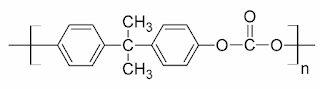
What are Polycarbonates? Polycarbonate (PC) are high-performance tough thermoplastic polymers that have organic functional groups linked together by carbonate groups (-O-(C=O)-O-).   Polycarbonates have high impact resistance and are obtained by condensation of diethyl carbonate or carbonyl chloride and bisphenol-A. It is widely used for bullet-proof windows and safety or crash helmets. Lexan is the most common example of Polycarbonates. Structure of Polycarbonate Preparation of Polycarbonate Polycarbonate is produced by condensation polymerization between bisphenol A and either Carbonyl chloride or diphenyl carbonate. (a) Preparation of Polycarbonate by condensation polymerization between bisphenol-A and Carbonyl Chloride The polymer is usually formed by the reaction of bisphenol-A and carbonyl chloride in a basic solution where polymerization takes place at the interface between the aqueous and organic layer with the help of a catalyst can amine. (b) Preparation of Polycarbonat...

Polyamides- Definition, Types, Properties and Applications

Image
What are Polyamides?  Polymers that have amide linkages are called polyamides. These are prepared by condensation polymerization of dibasic acids with diamines or their equivalents. Polyamides occur both naturally and artificially like proteins, such as wool and silk are naturally occurring polyamides whereas nylons, aramids and sodium poly(aspartate) is artificially manufactured polyamides. Following are some famous polyamides: 1. Nylon 6,6 Nylon 6,6 is a type of polyamide that is made of two monomers that is hexamethylenediamine and adipic acid each containing 6 carbon atoms. That's why it is called nylon 6,6. Nylon 6,6 has high mechanical strength, rigidity, and stability under heat and chemical attack. That's why it is used for making machine parts, airbags, ropes, conveyor belts, etc. Preparation of Nylon 6,6  It is prepared by the condensation polymerization of adipic acid and hexamethylenediamine. The acid and the amine first react to form a salt which when heated...