Posts

Nikto: Definition, Features and Disadvantages

Image
What is Nikto? Nikto is an open source (GPL) web server scanner which performs tests against 6700 potentially dangerous files and programs. Nikto also checks for outdated versions of over 1250 servers. It is created by David Lodge and Chris Sullo and its first version is released on 27, December 2001. It is written in the Perl programming language. It checks for the presence of multiple index files and HTTP server options. Features of Nikto 1. It can find SQL injection, XSS, and other common vulnerabilities. 2. It can identify installed software via headers, favicons, and files. 3. It can also guess the subdomains of the scanned domain. 4. The reports generated by it can be exported as plain text, XML, HTML, and CSV format. 5. It can be integrated with Nessus. 6. It exports to Metasploit. 7. It can be auto paused at a specific time. 8. It can be easily updated via the command line. 9. It includes support for SSL (HTTPS) websites. 10. It has full HTTP proxy support. Disadvantage o...

Nessus: Definition, Architecture and Features

Image
What is Nessus? Nessus is a proprietary vulnerability scanner developed by Tenable Inc. Nessus is an open source (under GPL license) network vulnerability scanner that has a database of common vulnerabilities which is matched with the vulnerabilities of the system. Nessus works by testing each port on the server/computer and then finding any potential vulnerabilities. Architecture of Nessus 1. Modular Architecture It provides flexibility to the tester to deploy the scanner and connect to the client from any machine with a web browser. 2. Plugin Architecture It provides flexibility to the tester to add plugins and groups into one of 42 families. Through this, users can easily add their test by selecting specific plugins. Features of Nessus Nessus is written in NASL language which is Nessus Attack Scripting Language which is designed specifically to write security tests easily and quickly. Nessus has an inbuilt feature of auto-updating its database which helps to update and disclos...

Vulnerability Assessment: Definition, Types and Importance

Image
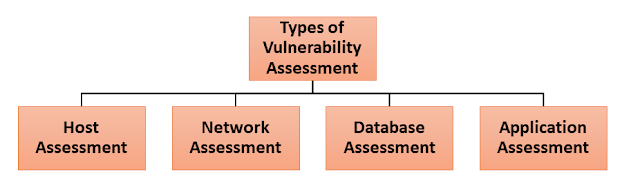
What is Vulnerability Assessment? The process of identifying security voids and weaknesses in an information system is known as vulnerability assessment. It checks and evaluates the suspected vulnerabilities in a system and provides information about its severity that is whether it is low, high, or critical, and suggests a way to mitigate them. Threats like SQL injection, XSS injection, DoS attack, etc on a system can be prevented by vulnerability assessment. Types of Vulnerability Assessment 1. Host Assessment It includes vulnerability assessment of servers, workstations, and other network hosts. This assessment examines ports and services that the host is using. 2. Network Assessment It includes vulnerability assessment of public and private networks on which the system is connected. This type of assessment can also detect vulnerabilities in wired and wireless networks. 3. Database Assessment It includes vulnerability assessment of databases or big data systems. This assessme...

Phases of Incident Response Plan in Cybersecurity

Image
An Incident response plan contains a series of phases that address a suspected data breach. Each phase contains some set of instructions that should be followed while implementing an incident response plan. Phases of Incident Response Plan  1. Preparation  This is the first phase of the incident response plan. In this phase, we ensure that the employees are properly trained and ready to deal with any security incident. We assign incidence response roles and responsibilities to each employee according to his skill. Also, in this phase, we conduct mock security, incidents in order to evaluate the capabilities of employees. 2. Identification In this phase, we identify the security incident on an organization's computer system. We also check how many systems are affected and their severity level. We also try to find out the source of that attack and analyze its degree of input on our computer systems and network. 3. Containment In this phase, we ensure that the breach doe...

Computer Security Incidents and their Types

Image
What is a Computer Security Incident? A computer security incident is an event related to the breach of data and security of a system due to failed protective measures. Computer security incident involves unauthorized access, use, breach, modification, or destruction of data. Types of Computer Security Incidents  Following are some types of computer security incidents: 1. Unauthorized Access Attack This type of security incident involves unauthorized access to a system by a malicious attacker or person. Cybercriminals can access the accounts of users to extract personal information like Bank details, Addresses, Contact details, etc, and use this information for causing harm. Two-factor authentication reduces the chances of unauthorized access attacks. 2. Privilege Escalation Attack This type of security incident happens when an attacker gains unauthorized access to a computer and also takes admin privileges or blocks the privileges of the original admin. This security incident al...

W3AF: Introduction, Architecture and Features

Image
What is W3AF? W3AF stands for web application attack and Audit framework. It is an open-source framework. It is an open-source framework for auditing and exploiting web applications. It provides facts about security vulnerabilities and bugs for use in penetration testing. The scanner offers a graphical user interface and a command line interface. It is written in python programming language and compatible will all major operating systems like windows, Linux, FreeBSD, etc. Architecture of W3AF The W3AF framework is divided into three parts: 1. The core coordinates the whole process and provides libraries for use in plugins. 2. The user interfaces, allow the user to configure and start scans. 3. The plugins, which find links and vulnerabilities. Features of W3AF 1. It provides web service support. 2. It exploits SQL injection (blind), O.S Commanding, remote file inclusions, local file inclusions, XSS, and more. 3. It provides good harmony among plug-ins. 4. It has a discovery plugin ...

Penetration Testing: Definition, Phases and Types

Image
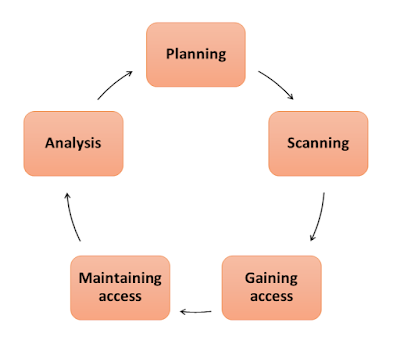
What is Penetration Testing? A simulated cyber attack performed on a computer system to check for exploitable vulnerabilities is called penetration testing or simply pen testing. Through regular penetration testing, we can discover new vulnerabilities in the system that are missed or omitted during a vulnerability assessment. Also, this helps the organization to set up a more secure computer and network system in the working ecosystem. Phases of penetration testing 1. Planning and Reconnaissance This phase includes gathering information about the target system through public and private sources like networks, domain names, mail servers, etc. This helps the pen testers to get preliminary information about the target system. 2. Scanning In this phase, pen testers use various tools to examine the target system vulnerabilities. Pen testers can scan the application's code in a running state and how it behaves during testing. 3. Gaining access In this phase, pen testers use web applic...

Life Cycle of Vulnerability Management

Image
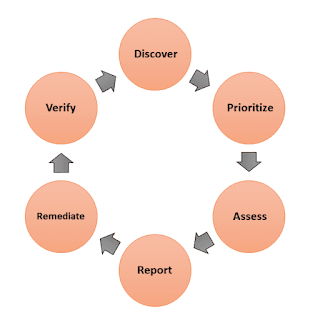
What is Vulnerability Management? Vulnerability management is a program that addresses common cybersecurity weaknesses in an organization's software, hardware, and network. These vulnerabilities can be exploited by hackers to steal data or do a brute-force attack. Therefore, vulnerability management helps to identify, close, and track these types of vulnerabilities and prioritize them in order of high risk to low risk. Life Cycle of Vulnerability Management 1. Discover This step involves the examination of operating systems, web services, hardware, web applications, and existing security patches to discover new vulnerabilities in the computer system. 2. Prioritize After the discovery of vulnerabilities, these are prioritized based on their nature which is informational, low, medium, high, and critical. The critical vulnerabilities should be dealt with first in the order of precedence. 3. Assess Now, assess all the vulnerabilities based on their severity. For example, low-risk vu...

Controlled Substance and its Acts

Image
What is Controlled Substance? A drug or any other substance which is strictly regulated by the government to prevent its abuse and addiction in normal people is known as a controlled substance. The control applies to the way the substance is manufactured, applied, managed, kept, and distributed. Control substances include opioids, stimulants, depressants, hallucinogens, and anabolic steroids. Certain controlled substances have great medical use like morphine, valium, etc they are available only by prescription from a licensed medical professional whereas other controlled substances don't have any medical applications like heroin, LSD, etc and they are completely banned in the country.  Different acts related to the regulation of controlled substances are as follows: 1. United States Controlled Substances Act Schedule 1 Drugs that have a high potential for abuse and do not have any medical application. For eg: Heroin, Lysergic acid diethylamide (LSD). Schedule 2 Drugs that lead to s...

Forensic Chemistry and its Applications

Image
What is Forensic Chemistry ? Forensic chemistry is the branch of forensic science that deals with the analysis of unknown chemical substances found at the scene of the crime like explosives, drugs, accelerants, poisons, etc. Forensic chemistry helps to link these substances with the suspect through different analytical techniques like HPLC, GC-MS, AAS, IR spectroscopy, FTIR, NMR Spectroscopy, etc . Moreover, the nature of these chemicals can also be identified by performing presumptive tests at the scene of the crime itself. Application of forensic chemistry In the arson case investigation, the potential accelerants used in arson present on the debris can be analyzed through techniques like gas chromatography-Mass spectroscopy. Gunshot residue present on the scene of the crime or the clothes of the victim/suspect can be analyzed under the scanning electron microscope. Forensic chemists examine evidence like blood stains, and urine to find traces of drugs, toxins, or poisons. Paper or t...

Information Warfare and it's Types

Image
What is Information warfare? Information warfare is a type of warfare that includes the use of information and communication technology to gain tactical and strategic advantage against the opponent. Information warfare technique is widely used by government or military to spread propaganda and disinformation against the opponent government or a country.  Information warfare reduces the operational cost of traditional weapons instead it utilizes the internet and network to spread disinformation into cyberspace. Types of information warfare 1. Personal Information warfare Personal information warfare is the art of obtaining the personal information of an individual without his knowledge or consent. This is done to steal personal information like name, age, work, and location and use it for unfair means methods to steal personal information are password checking, DNS attacks, malware attacks, DoS attack, etc. 2. Corporate information warfare Corporate information warfare is the act...

Cybersecurity and it's Types

Image
What is Cybersecurity? Cybersecurity is the practice of protecting computers, software, data, etc from hackers and malicious attackers. Cybersecurity is also known as Information security as all the information stored in computer and servers need to be secured.  Cybersecurity is essential because nowadays every organization like government, corporate, financial, medical, etc uses the Internet and computers. So, the chances of a security breach are high in them. Cybersecurity can be divided into the following categories: 1. Network security Network security is the process of protecting computers, mobile, etc connected to a network. For example, Network security is essential because nowadays every computer device or IoT device is connected to the internet or other Public/Private network. Hackers can use this network to penetrate these devices and compromise their security. 2. Application Security Application security is the process of protecting the computer applications like web...

Transportation Injuries in Forensic Medicine

Image
Introduction to Transportation Injuries These injuries are blunt force injuries that happen due to traveling on the ground, air, and water. The most common transportation injuries are motor and pedestrian injuries. Following are the various transportation injuries: Types of Transportation Injuries A) Vehicular Injuries These injuries are blunt force injuries that happen due to traveling on the ground either walking and being hit by some car or simply driving a car and crashing it. Those injured by accidents can be divided into three broad groups that are pedestrians, cyclists (Pedal or motor), and the drivers/passenger of vehicles. 1. Pedestrian Injuries (i) Primary Impact Injuries These injuries are produced when any part of the victim first strikes the vehicle. Generally, when an adult is hit by the front of a car, the front bumper will strike the victim at about knee level. This will help to establish the position of the victim and in crime scene reconstruction. The position of the...

Classification of Firearms

Image
1. Classification based on size and handling mechanism 1. Handguns Firearms that are short and compact and can be held in one hand. They have generally short barrels. They are further classified into two types: (a) Revolver A revolver is a short barrel firearm having a cylinder at the rear of the barrel. This cylinder has various chambers in which the cartridge is placed. When the trigger is pulled, the hammer facing one of the chambers of the cylinder strikes the primer of the cartridge, and hence the bullet fires. (b) Pistol A pistol is also a short barrel firearm having a magazine loaded with bullets. The magazine has a spring beneath it which push the new cartridge into the firing chamber after the previous bullet is fired and the process keeps going on till the magazine got empty. Pistols are available in all calibers ranging from 5 to 12 mm. 2. Shoulder Gun Firearms that are long barrels and relatively bigger and fired only with the assistance of a shoulder are known as should...

Methyl Orange: Introduction, Preparation, Applications

Image
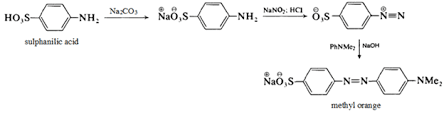
What is Methyl Orange? Methyl orange is a weak acid that breaks down into orange neutral molecules when it comes into contact with water. Methyl orange shows red color in the acidic medium and yellow color in the basic medium. That's why it is used as a pH indicator in titration due to its clear and distinct color variance properties at different pH. Preparation of methyl orange Methyl orange is prepared from sulphanilic acid N, N-dimethylaniline through a diazonium coupling reaction. The first product from the coupling is the bright red form of methyl orange, called helianthin. In the base, helianthin is converted to the orange sodium salt, called methyl orange. Mechanism of preparation of methyl orange The mechanism of this reaction is given below: Step 1:  Sulphanilic acid reacts with sodium carbonate extract and gets converted into sodium salt of p-amino benzene sulphonate Step 2: It undergoes a diazotization reaction in presence of nitrous acid to form diazonium chloride ...

Phases of Digital Forensics

Image
Following are the phases of digital forensics: (i) Collection of information/ Pre search consideration Before reaching the scene of the crime, the expert should have preliminary knowledge about the nature of the cybercrime. This information can be obtained from the first responding officer. Pre-search consideration helps the investigator to physically and mentally prepare for the crime and helps him to carry relevant tools to the scene of the crime.  Following are the three steps involved in pre-search consideration: (a) Securing and Evaluating In this stage, the expert asks questions regarding crime and pays special attention to the safety issues. He also checks the consent issues. (b) Conducting preliminary interviews Take the preliminary interview of the owner or user of the computer system found at the scene of the crime. If the system is password protected then an expert may ask the access to the system. Also, try to know the purpose of the use of a computer by the user. (c) D...

Digital Forensics and it's Branches

Image
What is Digital Forensics? The branch of forensic science that deals with the identification, collection, preservation, analysis, and reporting of any valuable digital evidence found at the scene of the crime is called digital forensics. It is also based on Locard's principle of exchange which states that "when a person comes into contact with an object, a mutual transfer of pieces of evidence takes place".  Here, digital forensic evidence like temporary files, commands, history, deleted data, etc can be found in the computer. Digital forensics helps the court of law in the conviction of criminals by studying digital evidence and maintaining a proper chain of custody. Branches of Digital Forensics Following are the branches of digital forensics: (i) Mobile forensics Mobile forensics is the branch of digital forensics that deals with the identification, collection, preservation, analysis, and reporting of any mobile device like a smartphone, tablet, etc found at the s...

Death: Definition, Types, Causes and Signs

Image
What is Death? Death is the irreversible cessation of all biological functions that helps to sustain an organism. The remains of a dead organism normally begin to decompose shortly after death. Death is an inevitable, a universal process that eventually occurs in all living organisms. Types of Death There are mainly two types of death 1. Somatic Death It is also known as clinical death . It refers to the complete and irreversible cessation of the function of the brain followed by the cessation of the function of the heart and lungs. 2. Molecular death It is also known as cell death. It refers to the complete and irreversible cessation of individual tissues of the cells. It takes place after the somatic death and in this type of death individual cells and other biomolecules in the system die.  This happens due to the loss of blood flow and oxygen for the survival of cells and tissues. Causes of death 1. Asphyxia The death of an individual due to interference with the intake of oxyge...

Mechanical Injuries: Definition, Types and Factors Affecting

Image
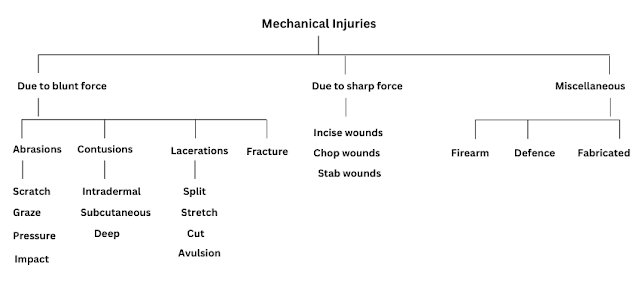
What are Mechanical Injuries? Injuries that are produced by any kind of mechanical force like blunt, sharp objects, firearms, etc are known as mechanical injuries. Injuries are defined as any harm to any person in body, mind, reputation, or property. Types of mechanical Injuries (A) Blunt force mechanical injuries Injuries caused by blunt force impact by objects like bat pipe, rod, etc are known as blunt force mechanical injuries. The injuries by blunt force produce abrasion, bruise, laceration, etc. 1. Abrasion Injury caused by the removal of the superficial epithelial layer of skin (generally epidermis) by friction against the rough surface is called abrasion. Following are the types of abrasion: (a) Scratch/ Linear Abrasion Linear abrasion is caused by a sharp or pointed object like a fingernail, thorn, or pin on the surface of the skin. It has some length but no significant width. (b) Graze abrasion (sliding/scrape/grinding abrasion) Graze abrasion is caused by horizontal or ta...