Posts

Styrene Copolymers: Types, Preparation, Properties and Applications
Image
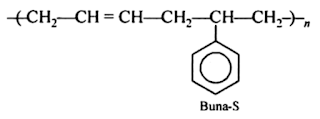
1. Butadiene-styrene Copolymer (SBR or Buna-S) Buna-S or SBR is a copolymer of 1,3-butadiene and styrene which is prepared by copolymerization of 1,3-butadiene and styrene along with sodium. In Buna-S, Bu stands for butadiene, Na for sodium which is the polymerizing agent and S stands for styrene. It is tough and is a good substitute for natural rubber. It possesses high abrasion resistance, high load-bearing capacity and is used for the manufacture of automobile tires. Preparation of Buna-S Styrene-butadiene rubber (SBR) or Buna-S can be prepared by copolymerization of a mixture of 1,3-butadiene and styrene in the ratio of 3:1 in the presence of sodium. Properties of Buna-S 1. Buna-S has high abrasion resistance, high bearing capacity, and resilience. 2. Buna-S is very tough and is a good substitute for natural rubber 3. Buna-S swells in organic solvents up to a limited extent. 4. Buna-S gets oxidized in the presence of traces of ozone. Applications of Buna-S 1. Buna-S is used for ...

Polyolefins: Types, Properties and Applications

Image
What are Polyolefins? A polymer that is produced from a simple olefin monomer (also called alkene having general formula CₙH₂ₙ) is called Polyolefin . For example (a) Polyethene is a polyolefin produced by polymerization of olefin ethylene (b) Polypropylene is a polyolefin produced by polymerization of olefin propylene. The IUPAC nomenclature of polyolefins is poly (alkene) . Polyolefins are produced by different common forming techniques like injection molding, blow molding, extrusion, and thermoforming using standard thermoplastic equipment. Due to low prices and easy processability, polyolefins have a variety of applications in the plastic industry. Application of Polyolefins 1. Polyolefins are used for making blow-molded components in toys. They are also used to make heat-shrink tubing which protects connections in electronic items. 2. Polyolefins are used in the pharmaceutical and medical industry for HEPA filter certification. 3. Polyolefins sheets have packaging applications of...

Polycarbonates: Structure, Preparation, Properties and Application

Image
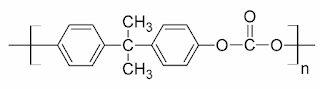
What are Polycarbonates? Polycarbonate (PC) are high-performance tough thermoplastic polymers that have organic functional groups linked together by carbonate groups (-O-(C=O)-O-).   Polycarbonates have high impact resistance and are obtained by condensation of diethyl carbonate or carbonyl chloride and bisphenol-A. It is widely used for bullet-proof windows and safety or crash helmets. Lexan is the most common example of Polycarbonates. Structure of Polycarbonate Preparation of Polycarbonate Polycarbonate is produced by condensation polymerization between bisphenol A and either Carbonyl chloride or diphenyl carbonate. (a) Preparation of Polycarbonate by condensation polymerization between bisphenol-A and Carbonyl Chloride The polymer is usually formed by the reaction of bisphenol-A and carbonyl chloride in a basic solution where polymerization takes place at the interface between the aqueous and organic layer with the help of a catalyst can amine. (b) Preparation of Polycarbonat...

Polyamides- Definition, Types, Properties and Applications

Image
What are Polyamides?  Polymers that have amide linkages are called polyamides. These are prepared by condensation polymerization of dibasic acids with diamines or their equivalents. Polyamides occur both naturally and artificially like proteins, such as wool and silk are naturally occurring polyamides whereas nylons, aramids and sodium poly(aspartate) is artificially manufactured polyamides. Following are some famous polyamides: 1. Nylon 6,6 Nylon 6,6 is a type of polyamide that is made of two monomers that is hexamethylenediamine and adipic acid each containing 6 carbon atoms. That's why it is called nylon 6,6. Nylon 6,6 has high mechanical strength, rigidity, and stability under heat and chemical attack. That's why it is used for making machine parts, airbags, ropes, conveyor belts, etc. Preparation of Nylon 6,6  It is prepared by the condensation polymerization of adipic acid and hexamethylenediamine. The acid and the amine first react to form a salt which when heated...

Poly (vinyl acetate): Structure, Preparation, Properties and Applications

Image
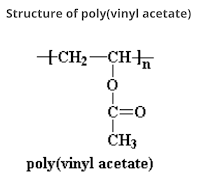
What is Poly (vinyl acetate)? Poly (vinyl acetate) (PVA) was discovered in Germany in 1912 by Fritz Klatte. It is an aliphatic rubbery synthetic polymer with chemical formula (C₄H₆O₂)n which belongs to the polyvinyl ester family. It is also known as wood glue or Elmers's glue due to its adhesive properties for which it is used as adhesive for porous materials like wood, paper, and cloth. Structure of Poly (vinyl acetate) (PVA) Preparation of Poly (vinyl acetate) (PVA) Poly (vinyl acetate) (PVA) is a vinyl polymer that is prepared by free radical vinyl polymerization of the monomer vinyl acetate. Properties of Poly (vinyl acetate) (PVA) 1. PVA is an amorphous polymer having a glass transition temperature (T𝘨) between 30-45 ℃ . 2. PVA offers good adhesion to most of the surfaces. 3. Degree of polymerization of PVA is between 100 to 5000 and it can be treated with alkali, which gradually results in polyvinyl alcohol and the alkali acetate. 4. PVA does not cross-link and it ca...

Polyurethanes: Definition, Preparation, Properties and Application

Image
What is Polyurethane? Polyurethane (PU) is a polymer having organic units joined by urethane (also known as carbamate). Urethane is a compound that has an O-R group and an NH-R group bonded to the same carbonyl carbon. Polyurethanes are thermosetting polymers but their thermoplastic variants are also available in the market. Polyurethanes are prepared by the polymerization of toluene-2,6-di-isocyanate and ethylene glycol. If the reaction is carried out in the presence of a blowing agent, the product is polyurethane foam. Preparation of Polyurethanes Polyurethanes are formed by reacting a polyol (an alcohol with more than two reactive hydroxyl groups per molecule like ethylene glycol) and di-isocyanate or a polymeric isocyanate in the presence of suitable catalyst and additives. Properties of Polyurethanes 1. Polyurethane has high load capacity in both tension and compression that may change shape under heavy load but will return to its original shape once the load is removed ...

10 Types of Dyes with their Properties and Dyeing Mechanism

Image
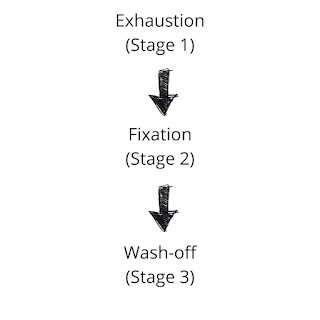
What is a Dye? A dye is a coloring substance that is used for giving color to different substances or altering the color of something. A dye chemically bonds to the substrate to which it is being applied and has an affinity to adhere to the solvent medium. A dye contains two groups that are chromophore and auxochrome groups in which a chromophore is a color-bearing group that is responsible for dye color whereas auxochrome is a color helper which is responsible for dye fiber reaction. Examples of dyes: Indigo dye , Phthalein dyes , Alizarin , etc. 10 Types of Dyes 1. Reactive Dyes Reactive dyes are those dyes that form a covalent bond between the dye and fiber. These dyes have a reactive group like halo-heterocycle or an activated double bond which once applied to a fiber with a hydroxyl group on the cellulosic fiber. In a reactive dye, chromophore has a substituent that is activated and allowed to directly react to the surface of the substrate. Some common examples of reactive dy...

Classification of Crystalline Solids

Image
What are Crystalline Solids ? We know that solids that have their constituent particles arranged in a definite pattern are called crystalline solids. So, depending upon the nature of these constituent particles, crystalline solids are further classified into four types: 1. Ionic solids 2. Molecular solids 3. Covalent or network solids 4. Metallic solids We will discuss all the above crystalline solids one by one. Classification of Crystalline Solids Following are the classification of crystalline solids: 1. Ionic Solids As the name suggests, crystalline solids that are made up of ions i.e cations and anions are called ionic solids. For example; NaCl is an ionic solid which contains Na⁺ and Cl⁻. These ions are held together by strong electrostatic attraction forces.  Properties of ionic solids Following are some properties of ionic solids: 1. They have high boiling and melting points due to the presence of strong electrostatic forces of attraction. 2. They are bad conductors...

Polystyrene: Definition, Preparation, Properties and Applications

Image
What is Polystyrene ? Polystyrene, also known as Polyvinyl benzene is hard, brilliantly transparent, stiff resin which is produced by the free radical addition polymerization of styrene in the presence of benzoyl peroxide. Polystyrene is non-biodegradable and widely used in the food-service industry as rigid trays, containers, disposable eating plates, bowls, etc. Preparation of Polystyrene Polystyrene is prepared by free radical addition polymerization of styrene in the presence of benzoyl peroxide as a catalyst. Properties of Polystyrene 1. Polystyrene exists in an amorphous state due to the presence of bulky phenyl groups which makes packing of Polystyrene inefficient. 2. Polystyrene is non-polar having a melting point of 240 ℃. 3. Polystyrene is a transparent polymer having a good optical property that allows high transmission of all wavelengths. 4. Polystyrene is hard but brittle due to the chain-shifting effect of the benzene ring. 5. Polystyrene has good insulation properti...

Bakelite and Novolac- Phenol Formaldehyde Resins

Image
What are Phenol formaldehyde resins? Phenol formaldehyde resins (PF) or Phenolic resins are the oldest synthetic polymers. These are obtained by condensation of phenol with formaldehyde in the presence of either an acid or a base catalyst. Phenol formaldehyde resin possesses excellent adhesive properties and is usually used as bonding glue. They can withstand very high temperatures and are resistant to non-oxidizing acids, salts, and many organic solvents. Examples of Phenol formaldehyde resins Following are the most common examples of Phenol formaldehyde resins: 1. Bakelite Bakelite is a thermosetting phenol-formaldehyde resin that was developed by Belgian-American chemist Leo Baekeland in 1907. Bakelite is a cross-linked condensation copolymer that is prepared by a condensation reaction of phenol with formaldehyde in the presence of either acid or base catalyst. Preparation of Bakelite The reaction begins with the formation of o- and p-hydroxymethyl phenol derivatives which f...

Poly (methyl methacrylate) (PMMA): An Acrylic Polymer

Image
What are Acrylic Polymers ? Acrylic Polymers, commonly known as acrylics are strong, stiff, and transparent plastic materials. They are prepared by free-radical polymerization of monomers that belong to ester acrylate (R=H) and methacrylate (R=CH₃) families. Acrylic Polymers are found in the market under the trade names perspex, Acrylite, Europlex, Optix, Duraplex, and Plexiglass. They are used for lighting, electronics screen, automotive components, and outdoor glazing in architecture and construction. Most common Acrylic Polymer: Poly (methyl methacrylate) (PMMA) Poly (methyl methacrylate) (PMMA) is a transparent thermoplastic that is used in sheet form as a lightweight or shatter-resistant alternative to glass. It is a synthetic polymer of methyl methacrylate which is prepared by free radical polymerization of this monomer. Preparation of Poly (methyl methacrylate) (PMMA) Poly (methyl methacrylate) (PMMA) is a vinyl polymer that is prepared by free radical polymerization...

Biodegradable Polymers: Definition, Examples, Properties and Applications

Image
What are Biodegradable Polymers? Polymers such as polysaccharides (starch, cellulose, etc), proteins, and nucleic acid that can disintegrate themselves in biological systems during a certain period by enzymatic hydrolysis and by oxidation, are called biodegradable polymers. These polymers do not have a disposable problem and they do not cause pollution like their other counterpart polymers. Moreover, their availability is good and they are non-toxic. The most important class of biodegradable polymers are aliphatic polyesters are polyamides. Examples of Biodegradable Polymers Some common examples of biodegradable polymers are given below: (i) Poly-b-hydroxybutyrate-co-b-hydroxyvalerate (PHBV) It is a thermoplastic copolymer of 3-hydroxybutyric acid and 3-hydroxypentanoic acid in which two monomer units are connected by ester linkages. It is used in specialty packaging, orthopedic devices, and controlled drug release.  For example, when a drug is enclosed in a capsule of PHBV, i...