Posts

IR Spectroscopy: Definition, Instrumentation, Working and Applications
Image
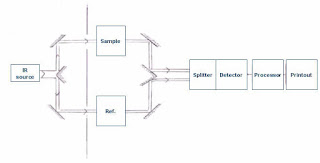
What is IR Spectroscopy? Infrared spectroscopy is absorption spectroscopy that deals with the recording of the absorption of the electromagnetic radiations of the infrared region of the electromagnetic spectrum. The IR region ranges from 700-1000 nm.   This technique is widely used for the detecting of functional groups, characterization of proteins, analysis of various liquids, and identification of molecules and their composition. Instrumentation of IR spectroscopy 1. Radiation source The radiation source should emit IR electromagnetic radiations which are steady, intense, and extended over the desired wavelength. That's why radiation sources like Nernst glower, globar source, incandescent lamp, and mercury arc lamp. 2. Monochromator It helps to select desired frequencies of IR radiations because our sample will only absorb some specific frequencies of IR radiations. Prism and grating are the most commonly used monochromators. 3. Sample cells and sampling IR spectroscopy is ...
U.V-Visible spectroscopy: Instrumentation, Working and Applications

Image
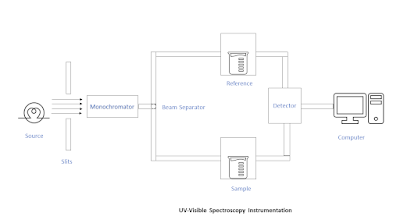
What is U.V-Visible spectroscopy? U.V-Visible spectroscopy is absorption spectroscopy that deals with the recording of the absorption of electromagnetic radiation of the U.V and Visible regions of the electromagnetic spectrum. The U.V-region ranges from 200-400 nm whereas the visible region ranges from 400 to 800 nm.   So, we can say that U.V-Visible spectroscopy utilizes a 200-800 nm range for working. This technique is widely used for detecting the presence and elucidating the nature of the conjugated multiple bonds and aromatic rings. Instrumentation of U.V-Visible spectroscopy 1. Radiation source Hydrogen-discharge lamp is the most commonly used source of radiation in the U.V region (200-400 nm) whereas a deuterium-discharge lamp is used when more intensity (3-5 times) is desired. A tungsten-filament lamp is used when absorption in the Visible region (400-800 nm) is to be determined. 2. Monochromator It helps to separate the radiations into separate wavelengths that are it...

Forensic Anthropology: Definition, History and Application

Image
What is Forensic Anthropology? Forensic anthropology is a specialized branch of physical anthropology that deals with the medico-legal purpose to establish the identity of the deceased person. It uses the knowledge of human anatomy like the size of bones, hairs, length, features of bones, teeth, etc to determine the person's age, sex, stature, and race. In some cases, it can also predict the cause of death of the person by studying the different features on the bone. Forensic anthropologists are often called to the scene of the crime to study the remains of human remains which got decomposed, burned, mutilated, or difficult to recognize. Forensic anthropology can be used in accident cases like aircraft crashes, arson, fire accidents, genocide, etc. History of Forensic Anthropology The history of forensic anthropology dates back to the 19th century when anatomists were often asked for human identification through their skeletal. In 1835, Mathieu Orfila , a french forensic medicine ...

Process of Dyeing Fabric

Image
To dye fiber with a dye, some certain steps are to be followed only then dye molecules will get fixed on the fiber and we will get our desired colored fiber. So, the following are some steps that are to be followed during the dyeing process: 1. Sourcing and Bleaching In this type, fiber is collected from the source and any loose, hairy or gummy materials are removed from the fiber. Then, impurities or any natural color of the fiber are removed through bleaching. 2. Preparation of Dye bath In this step, a dye bath is prepared in which the whole process of dyeing a textile fiber takes place. A dye bath contains dye and water which is generally heated to get a proper mixture. 3. Coloration In this step, textile fiber is colored through dyeing. The color should not readily be removed by rinsing in water or by normal washing procedures. Also, the color should not fade by exposure to light. Following are the phenomenon involved at the molecular level during the coloration of textile mater...

History and Development of Forensic Science

Image
The term 'forensic' is obtained from the Latin word 'Forensis' which means "court of justice" . So we can say, forensic science is a branch of science that deals with the individualization, recognition, identification, and evaluation of physical evidence by the use of natural science for criminal justice. Forensic science is also known as 'criminalistics' in some countries with branches like fingerprints, documents, ballistics, odontology, etc. It is derived from major branches of science like physics, biology, and chemistry. In the 19th century when natural science began to develop rapidly, forensic science started deepening its roots in criminal justice. Forensic science was widely accepted because there is no place for the torture of criminals for detecting crime in a civilized society.  Forensic science was made more famous by sir Arthur Conan Doyle's fictional character 'sherlock homes' in which crime investigation is done by scie...

Documentation of the Crime Scene: Step by Step

Image
What is documentation of the crime scene and Why it is done? After securing the crime scene, the next most important step is documentation of the crime scene because documentation permanently records the crime scene and its physical evidence. Documentation should be done without any wastage of time as the scene and its evidence may get altered over time. The documentation should be done innovatively and the originality of the crime scene should be maintained and documentation should not have pauses or breaks, it should remain constant till the whole crime scene is documented. There are four main tasks of documentation that is note-making, photography, videography , and sketching . It should be noted that all four tasks are necessary and none is a substitute for another. For example, notes are not substitutes for photography, video is not a substitute for sketching, etc. Following are the sequence for crime scene documentation: 1. Note making Documentation of crime scene in the f...

Phenolphthalein: Preparation, Properties and Applications

Image
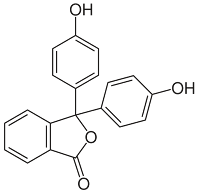
What is Phenolphthalein? Phenolphthalein is an organic compound having the chemical formula C₂₀H₁₄O₄ that is used as a ㏗ indicator in acid-base titrations. So, as an indicator, it turns pink to red in alkaline and is colorless in acid solutions. In short, it can be written as 'HIn' or '㏗㏗'. Preparation of Phenolphthalein Phenolphthalein can be synthesized by condensation of phthalic anhydride with two equivalents of phenol under acidic conditions. Properties of Phenolphthalein Phenolphthalein is white-yellow, in its crystalline form. It is readily soluble in alcohols and mildly soluble in water. It does not have taste or smell and it is carcinogenic. It appears colorless till pH 8.5 and above that it appears as pink to deep red. Applications of Phenolphthalein It is commonly used as an indicator in acid-base titrations. It turns colorless in acidic solutions and pink in basic solutions. It may be used as a laxative but it is not advisable due to the suspected car...

Essential Elements in a Biological System and their Role

Image
What are the essential elements in a biological system ? As the name suggests, elements that are essential or necessary for the life process are called essential elements . For example, Oxygen, Carbon, Hydrogen, Nitrogen, etc. Metals like Ca, Ni, Co, Zn , etc. are responsible for initiating or inhibiting reactions in biological systems. That's why in bioinorganic chemistry we investigate these metals in terms of their nutrition, toxicity, storage, and transport in biological systems. These elements are a must for normal growth and reproduction in living organisms and cannot be replaced by other elements. So, the following are some common essential elements that are found in humans and plants. 1. Calcium (Ca) Calcium is a critical essential element in all animals and human beings. A healthy human adult has about 1.05 Kg of calcium, out of which 99% exists as phosphates, resembling the mineral hydroxyapatite [Ca₁₀(PO₄)₆(OH)₂] in bones and teeth. The small remainder of calcium is ...

Classification of Natural Dyes

Image
Classification of Natural Dyes Dyes which are obtained from natural resources like plants, animals, and minerals are known as natural dyes .  So, natural dyes can be further classified into three types. 1. Natural Dyes obtained from Plants Dyes that are obtained from plant sources like roots, berries, bark, leaves, and wood are known as plant-based natural dyes .  For example, Logwood, Indigo, Henna, etc. They are also known as vegetable dyes and can be applied directly or with different mordants. 2. Natural dyes obtained from Animals Dyes that are obtained from animal sources like insects and invertebrates are known as animal-based dyes. Various shades of red and purple colors can be obtained from animal origin.  Cochineal, Tyrian Purple, and Lac are some common examples of animal dyes. 3. Natural dyes obtained from minerals Dyes that are obtained from mineral sources are called mineral dyes. They are produced by the metallic ions in the mordant salts.  Shades of ...

Edible Dyes: Definition, Types, Properties and Applications

Image
Definition of Edible Dyes Dyes that impart color when it is added to food or drink and can be consumed, are known as edible dyes . They come in many forms like powders, gels, and pastes and can be used in drinks, cookies, candies, etc. Types of Edible Dyes Based on the source, edible dyes are further classified into two types is Natural edible dyes and Synthetic edibles dyes. 1. Natural Edible Dyes Dyes that are obtained from natural sources like plants, leaves, flowers, seeds, roots, and animals are called natural dyes. Since they are obtained from natural sources, so there will be no harm to use natural edible dyes in preparing attractive food. Natural edible dyes also contain vitamins that are very essential for the body. Adding these ayes in food does not affect the taste of food and makes the food look more attractive. Examples of natural edible dyes are Annatto, Turmeric, Carmine, Paprika, etc. 2. Synthetic Edible Dyes Dyes that are obtained from petroleum-derived substanc...

Vulcanization of Rubber: Definition, Properties and Applications

Image
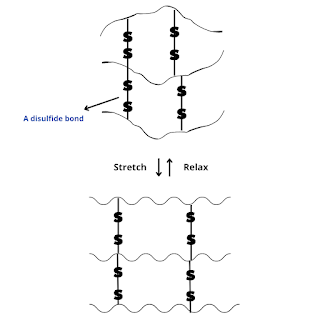
What is Vulcanization of rubber ? As we know that, natural rubber is soft and sticky and becomes even more so at high temperatures and brittle at low temperatures. Also, it is not resistant to the action of organic solvents and can be easily attacked by oxidizing agents.  So, to solve this problem, Charles Goodyear in 1839, found a process called Vulcanization , which can improve the physical and chemical properties of rubber. Vulcanization is a process that consists of heating raw rubber with sulfur at 373-415 K temperature. Since this process is slow, therefore additives like zinc oxide are used to accelerate the rate of vulcanization. During vulcanization, sulfur bridges or cross-links between polymer chains are introduced either at their reactive allylic positions or at the sites of the double bonds.  These cross-links make rubber hard and stronger and remove the stickiness of natural rubber because the individual chains can no longer lip over but are instead locke...

Types of Rubber, their Properties and Applications

Image
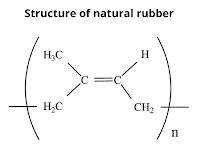
1. Natural Rubber Natural rubber is a natural polymer that is manufactured from latex which is a colloidal solution of rubber particles in water. Latex is obtained by making cuts in the bark of rubber trees like Hevea brasiliensis, found in tropical and semi-tropical countries such as southern. India, Indonesia, Malaysia, Sri Lanka, South America, etc. The natural rubber has remarkable elasticity and undergoes long-range reversible extension even under a relatively small applied force. Preparation of natural rubber Natural rubber is a linear 1,4-addition polymer of isoprene. Since each repeating unit in polyisoprene contains a double bond having cis-stereochemistry. That's why natural rubber is cis-polyisoprene. Properties of Natural rubber Natural rubber has no polar groups and hence intermolecular forces of attraction are only weak van der Waals interactions. Cis-polyisoprene does not have a straight-chain but has a coiled structure. As a result, it can be stretched like a spri...

Malachite Green: Definition, Synthesis, Properties and Applications

Image
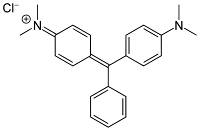
What is Malachite Green? Malachite green is a type of Triphenyl methane dye that is used as a dyestuff for materials like silk, leather, and paper. It is bright green and can be used as an antimicrobial agent in aquaculture. Synthesis of Malachite Green Malachite green can be prepared by reaction of Benzaldehyde with N, N-dimethyl aniline in the presence of H₂SO₄ to form a triphenylmethane derivative. The subsequent oxidation with PbO₂ followed by treatment with an excess of concentrated HCl yields a green dye known as malachite green. Properties of Malachite Green Malachite green is green, crystalline, and water-soluble. Leuco form of malachite green is electrically neutral and undergoes a photoionization reaction that yields the cationic form of malachite green. It is toxic, thus not advisable to consume. Applications of Malachite Green It is used as a dye to color materials like silk, leather, and paper. It is used as an antiseptic for bacterial infection. It is used to catch thi...

Conducting Polymers: Definition, Examples, Properties and Applications

Image
What are Conducting Polymers? As the name suggests organic polymers that conduct electricity are known as conducting polymers. They are also known as intrinsically conducting polymers (ICPs) and they have alternating single and double bonds along the polymer backbone (conjugated bonds) or that are composed of aromatic rings such as Phenylene, naphthalene, anthracene, pyrrole, and thiophene which are connected through carbon-carbon single bonds. Examples: Polyacetylene, Polypyrrole, Polyaniline, etc What is the reason behind conducting nature of these polymers? Conducting polymers comes in two forms that are doped conducting polymers and non-doped conducting polymers. The conductivity of non-doped conjugated polymers is due to the existence of a conductivity band similar to a metal. In a conjugated polymer, three of the four valence electrons form strong sigma bonds through sp² hybridization where electrons are strongly localized. The remaining unpaired electron of each carbon atom re...